matrix_along_axis()#
- Derivative.matrix_along_axis(axis: int, diff_type: Literal['forward', 'backward'] = 'forward', boundary: Literal['dirichlet', 'neumann', 'periodic'] = 'dirichlet') csr_arraySource#
Derivative matrix along the specified axis.
Note
If the grid has masked area, edges before the masked area take either the dirichlet (forward) or neumann (backward) condition. The periodic boundary condition is only available for the last and first points along the axis.
- Parameters:
- axis
int The axis to calculate the derivative matrix. The axis must be in the grid dimensions.
- diff_type{“forward”, “backward”},
optional The type of the difference method, by default “forward”.
- boundary{“dirichlet”, “neumann”, “periodic”},
optional The boundary condition of the derivative matrix, by default “dirichlet”. If the boundary condition is “dirichlet”, the outer boundary is set to zero. If the boundary condition is “neumann”, the difference type is set to the opposite direction at the edge of the grid. If the boundary condition is “periodic”, the first and last points are connected.
- axis
- Returns:
csr_arrayThe derivative matrix along the specified axis.
Examples
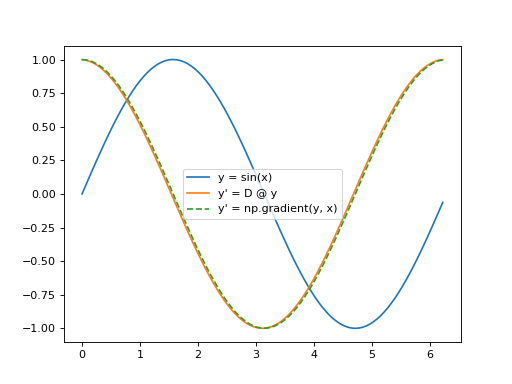
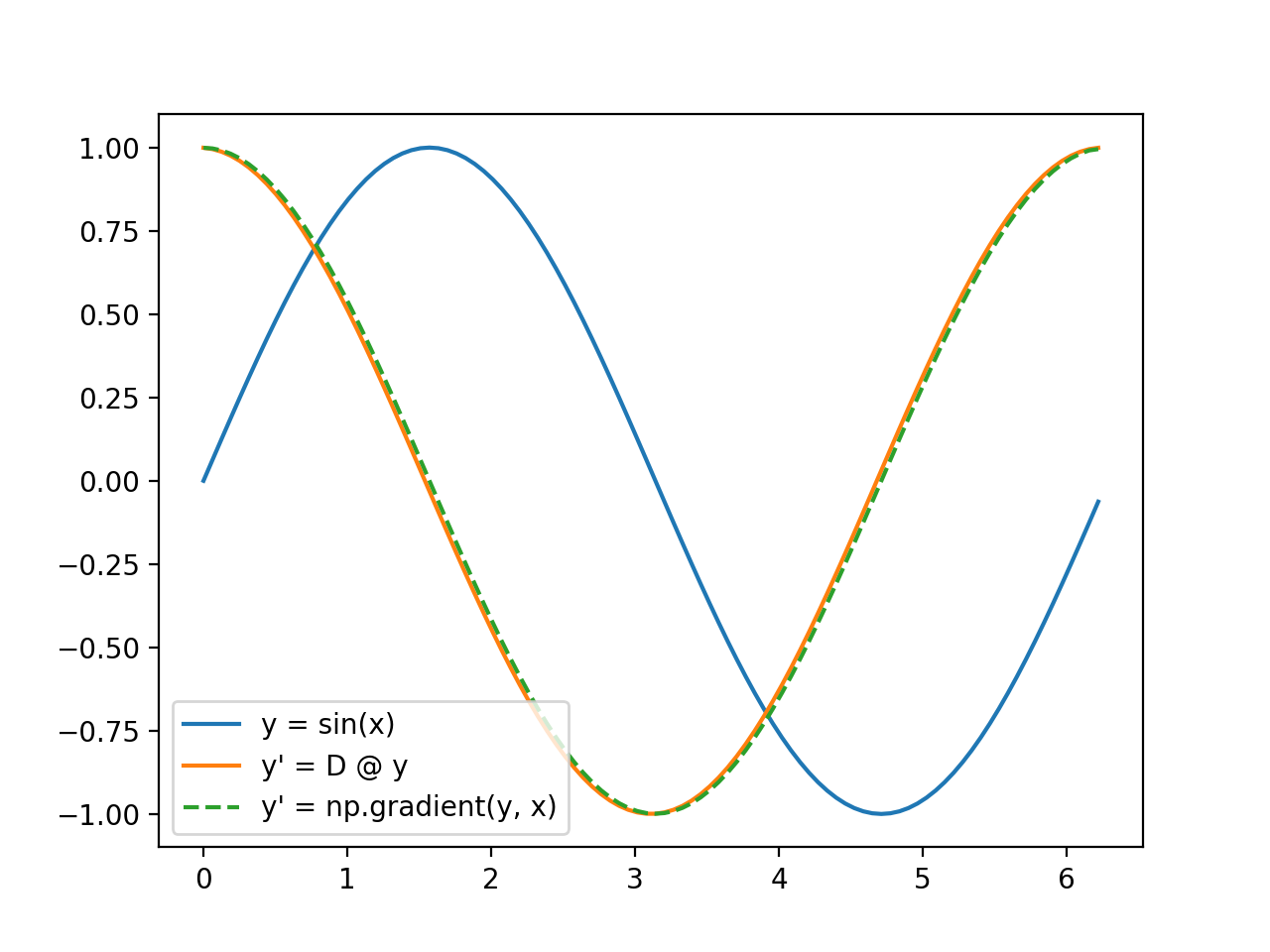
Firstly, let us operate the derivative matrix to a simple 1-D profile and compare it with gradient values calculated by the
numpy.gradientfunction.import numpy as np import matplotlib.pyplot as plt from cherab.inversion import Derivative # Create a sample 1-D sine profile x = np.linspace(0, 2 * np.pi, 100, endpoint=False) y = np.sin(x) # Calculate the derivative matrix derivative = Derivative(x) dmat = derivative.matrix_along_axis(0, boundary="dirichlet") # Compare gradient values plt.plot(x, y, label="y = sin(x)") plt.plot(x, dmat @ y, label="y' = D @ y") plt.plot(x, np.gradient(y, x), label="y' = np.gradient(y, x)", linestyle="--") plt.legend() plt.show()
(
Source code,png,hires.png,pdf)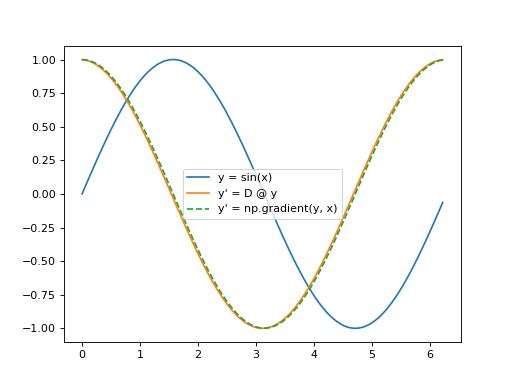
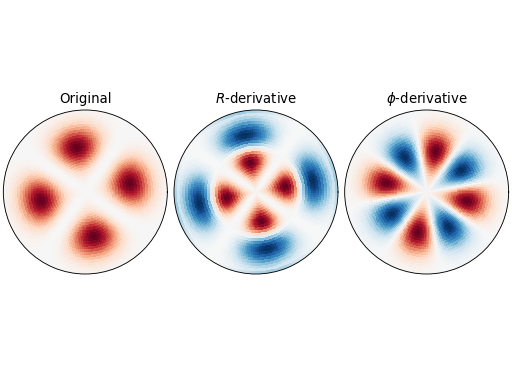
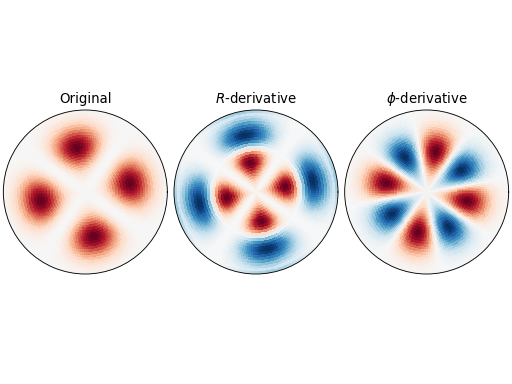
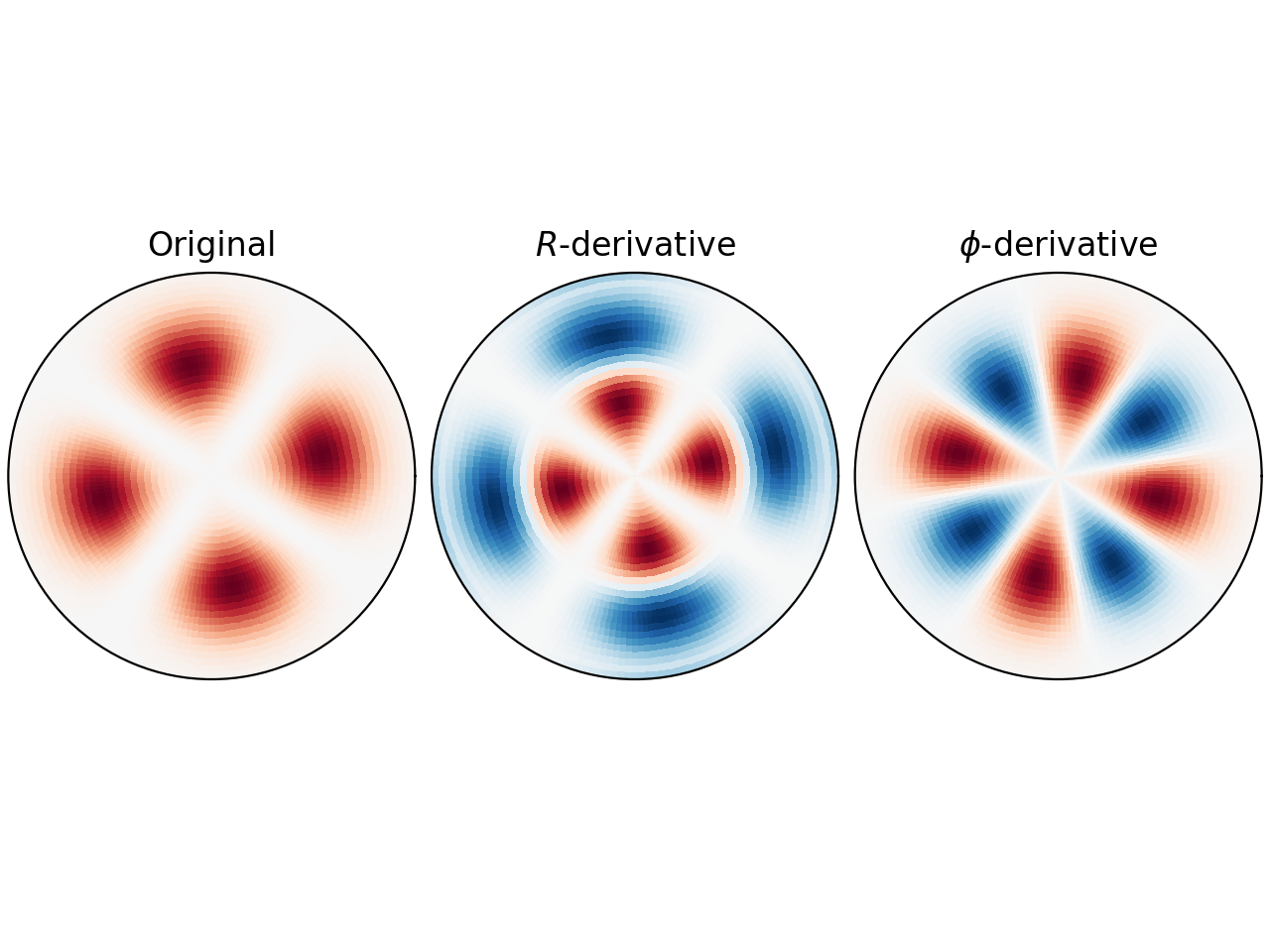
Next, we create a sample 2-D profile in cylindrical coordinates and apply the derivative along the R and Phi axis to the profile.
import numpy as np
from matplotlib import pyplot as plt
from matplotlib.gridspec import GridSpec

from cherab.inversion import Derivative

# R-Phi grids
radius = np.linspace(0.1, 1, 30)
angles = np.linspace(0, 2 * np.pi, 180, endpoint=False)

# Create voxels center coordinates in (x, y, z)
rr, pp = np.meshgrid(radius, angles)
centers = np.zeros((30, 180, 1, 3))
centers[:, :, 0, 0] = (rr * np.cos(pp)).T
centers[:, :, 0, 1] = (rr * np.sin(pp)).T
centers[:, :, 0, 2] = 0

# Create a 2-D profile
indices = np.ndindex(centers.shape[:3])
profile = np.zeros(centers.shape[:3])

CENTER = 0.6
WIDTH = 0.05
PHASE = -np.pi / 4
for ir, ip, iz in indices:
    profile[ir, ip, iz] = (1 + np.cos(angles[ip] * 4 + PHASE)) * np.exp(
        -((radius[ir] - CENTER) ** 2) / WIDTH
    )


# Operate derivative
deriv = Derivative(
    centers,
    np.arange(np.prod(centers.shape[:3]), dtype=np.int32).reshape(centers.shape[:3]),
)
dmat_r = deriv.matrix_along_axis(0, diff_type="forward", boundary="dirichlet")
dmat_p = deriv.matrix_along_axis(1, diff_type="forward", boundary="periodic")

profile_dr = dmat_r @ profile.ravel()
profile_dp = dmat_p @ profile.ravel()
profile_dr = profile_dr.reshape(centers.shape[:3])
profile_dp = profile_dp.reshape(centers.shape[:3])

# Plot the profiles
fig = plt.figure(layout="constrained")
gs = GridSpec(1, 3, figure=fig)
for i, (f, title) in enumerate(
    zip(
        [profile, profile_dr, profile_dp],
        ["Original", "$R$-derivative", "$\\phi$-derivative"],
        strict=True,
    )
):
    ax = fig.add_subplot(gs[i], projection="polar")
    ax.grid(False)
    ax.pcolormesh(
        angles,
        radius,
        f[..., 0],
        cmap="RdBu_r",
        vmax=np.amax(np.abs(f)),
        vmin=-np.amax(np.abs(f)),
    )
    ax.set_rticks([])
    ax.set_thetagrids([])
    ax.set_title(title)

plt.show()
(
Source code,png,hires.png,pdf)