Note
This page was generated from notebooks/non-iterative/gcv.ipynb.
GCV criterion#
Here we show how to use the Generalized Cross Validation (GCV) criterion to select the optimal regularization parameter for an example ill-posed inverse problem. The definition of the GCV criterion is introduced in this page.
Definition of the example problem#
We refer to the famous Fredholm integral equation of the first kind devised by Phillips[1]. Define the function
Then, the kernel \(K(s, t)\) and the solution \(x(t)\) are given by
Both integral intervals are \([-6, 6]\).
[1]:
import numpy as np
from matplotlib import pyplot as plt
from scipy.sparse import diags

from cherab.inversion import GCV, compute_svd
from cherab.inversion.tools import parse_scientific_notation

plt.rcParams["figure.dpi"] = 150
Let us define functions for the kernel, the solution and the right-hand side.
[2]:
Then we will generate the discretized version of the kernel \(\mathbf{K}\), solution \(\mathbf{x}\) and right-hand side \(\mathbf{b}\) using the trapezoidal rule leading to the following linear system:
The size of matrix \(\mathbf{K}\in\mathbb{R}^{M\times N}\) is set to \(M = N = 64\).
[3]:
s = np.linspace(-6.0, 6.0, num=64, endpoint=True)
t = np.linspace(-6.0, 6.0, num=64, endpoint=True)

# discretize kernel
k_mat = np.zeros((s.size, t.size))
k_mat = np.array([[kernel(i, j) for j in t] for i in s])

# trapezoidal rule
k_mat[:, 0] *= 0.5
k_mat[:, -1] *= 0.5
k_mat *= t[1] - t[0]

# discretize solution
x_t = np.array([solution(i) for i in t])

print(f"{k_mat.shape = }")
print(f"{x_t.shape = }")
print(f"condition number of K is {np.linalg.cond(k_mat):.4g}")
k_mat.shape = (64, 64)
x_t.shape = (64,)
condition number of K is 5.924e+04
The right-hand side \(\mathbf{b}\in\mathbb{R}^{M}\) is usually contaminated by noise. So, we will add a Gaussian noise to the right-hand side.
where \(\bar{\mathbf{b}}\) is the original right-hand side (\(\bar{\mathbf{b}}\equiv \mathbf{K}\mathbf{x}\)), \(\mathbf{e}\) is a vector whose elements are independently sampled from the normal distribution with mean 0 and standard deviation \(10^{-3}\).
[4]:
b_bar = k_mat @ x_t
rng = np.random.default_rng()
noise = rng.normal(0, 1.0e-3, b_bar.size)
b = b_bar + noise
Solve the inverse problem using the GCV criterion#
The solution of the ill-posed linear equation is obtained with the regularization procedure:
where \(\mathbf{H}\) is the regularization matrix. Here we set \(\mathbf{H} = \mathbf{D_2}^\mathsf{T}\mathbf{D_2}\), where \(\mathbf{D_2}\) is the second-order difference matrix.
dmat.shape = (64, 64)
Then we create GCV solver object after calculating the singular value decomposition according to the series expansion of solution.
[6]:
hmat = dmat.T @ dmat
s, u, basis = compute_svd(k_mat, hmat)
gcv = GCV(s, u, basis, data=b)
Let us solve the inverse problem.
                    message: ['requested number of basinhopping iterations completed successfully']
                    success: True
                        fun: 1.9460397895292555e-08
                          x: [-2.269e+00]
                        nit: 100
      minimization_failures: 0
                       nfev: 410
                       njev: 205
 lowest_optimization_result:  message: CONVERGENCE: NORM_OF_PROJECTED_GRADIENT_<=_PGTOL
                              success: True
                               status: 0
                                  fun: 1.9460397895292555e-08
                                    x: [-2.269e+00]
                                  nit: 0
                                  jac: [-4.360e-10]
                                 nfev: 2
                                 njev: 1
                             hess_inv: <1x1 LbfgsInvHessProduct with dtype=float64>
Evaluate the GCV criterion#
Next we evaluate the solution obtained by the GCV criterion
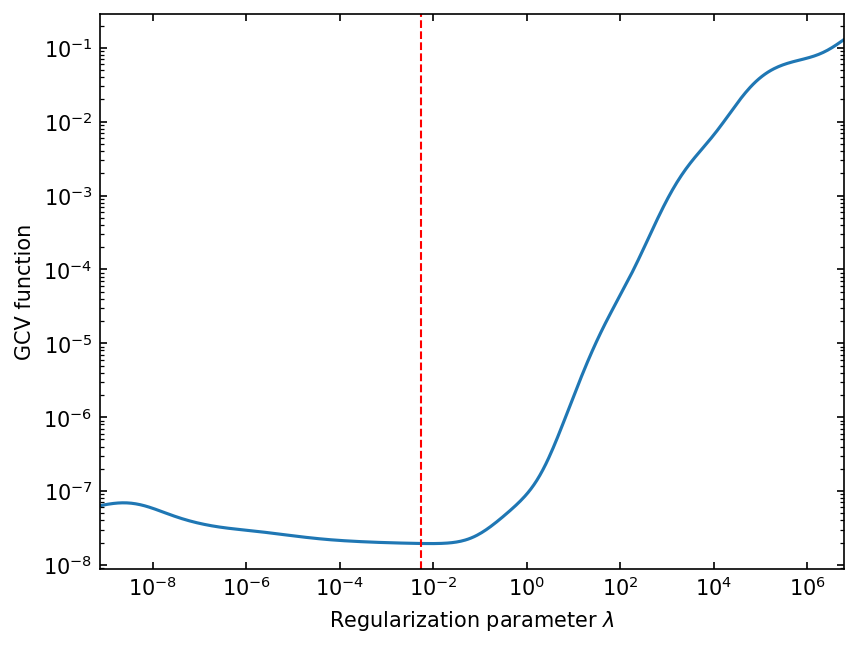
Plot GCV curve#
[8]:
gcv.plot_gcv();
Compare \(\mathbf{x}_\lambda\) with \(\mathbf{x}_\mathrm{true}\)#
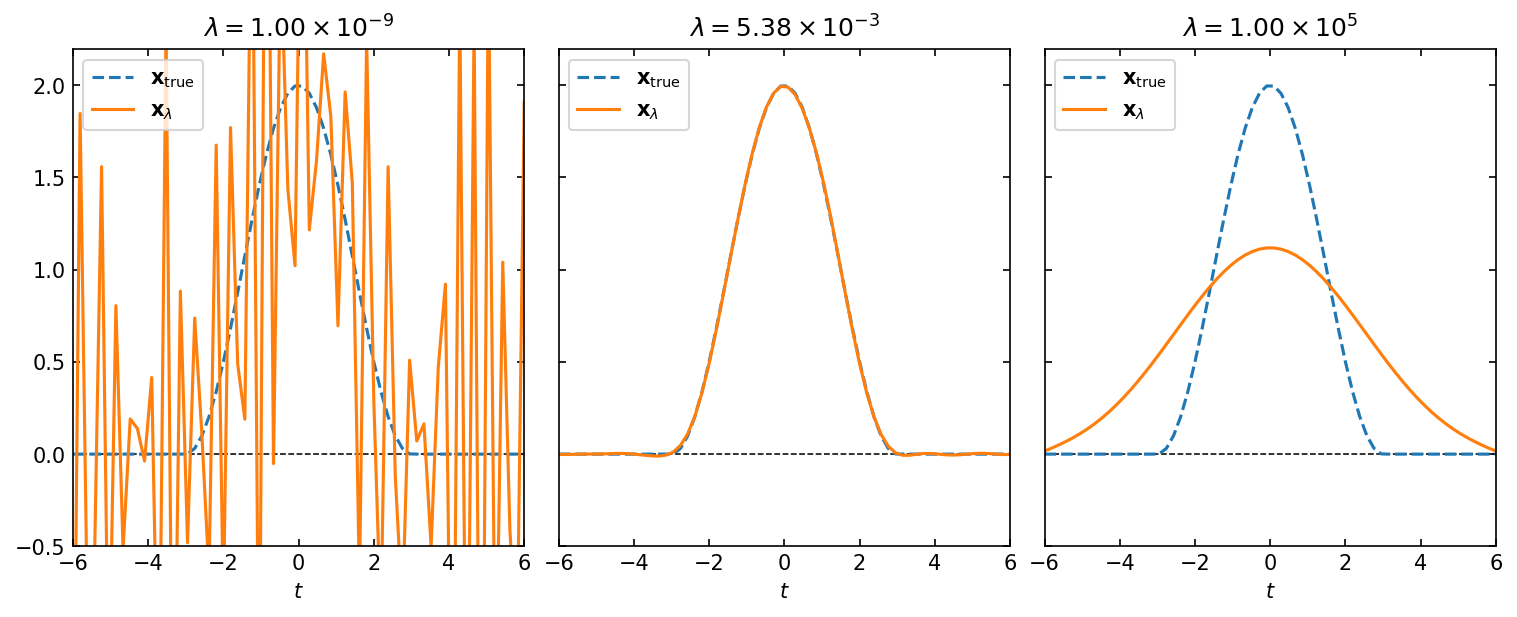
Let us compare solutions at different regularization parameters \(\lambda=10^{-9}\), \(\lambda_\text{opt}\), \(10^5\) with the true solution \(\mathbf{x}_\mathrm{true}\).
[9]:
lambdas = [1.0e-9, gcv.lambda_opt, 1.0e5]

fig, axes = plt.subplots(1, 3, figsize=(10, 4), sharey=True, layout="constrained")

for ax, beta in zip(axes, lambdas, strict=False):
    ax.plot(t, x_t, "--", label="$\\mathbf{x}_\\mathrm{true}$")
    ax.plot(t, gcv.solution(beta=beta), label="$\\mathbf{x}_\\lambda$")
    ax.axhline(0, color="black", lw=0.75, ls="--", zorder=-1)

    ax.set_xlim(t.min(), t.max())
    ax.set_ylim(-0.5, x_t.max() * 1.1)
    ax.set_xlabel("$t$")
    parsed_lambda = parse_scientific_notation(f"{beta:.2e}")
    ax.set_title(f"$\\lambda = {parsed_lambda}$")
    ax.tick_params(direction="in", labelsize=10, which="both", top=True, right=True)
    ax.legend(loc="upper left")
Check the relative error#
The relative error between the solution \(\mathbf{x}_\lambda\) and the true solution \(\mathbf{x}_\mathrm{true}\) is defined as follows:
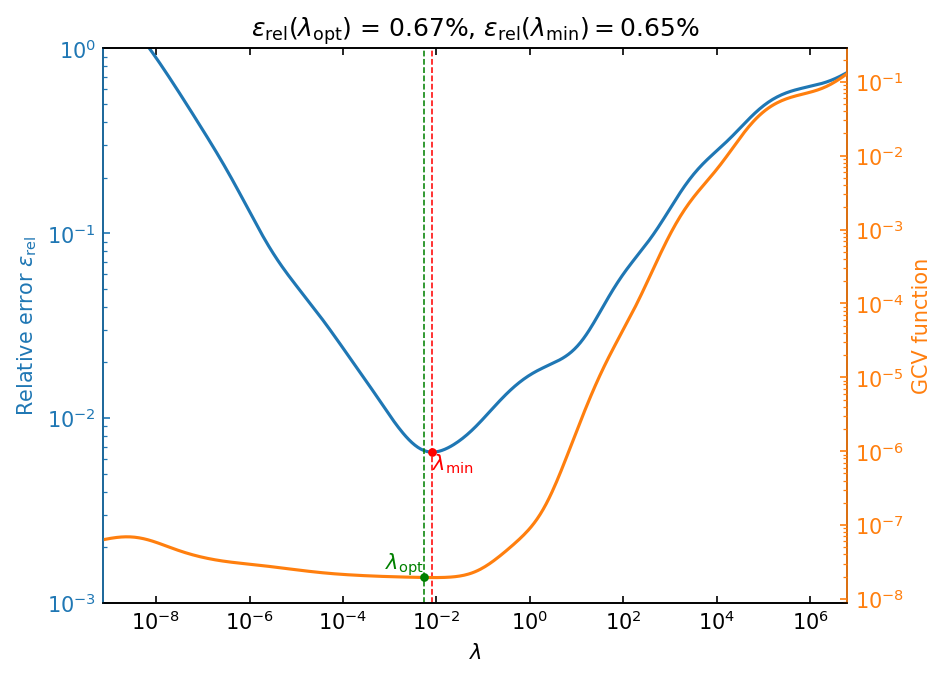
Let us seek the minimum \(\epsilon_\mathrm{rel}\) as a function of \(\lambda\).
[10]:
from scipy.optimize import minimize_scalar

X_T_NORM = np.linalg.norm(x_t, axis=0)


def relative_error(
    log_lambda: float, x_t: np.ndarray = x_t, x_t_norm: float = X_T_NORM, gcv: GCV = gcv
) -> float:
    """Calculate relative error."""
    beta = 10**log_lambda
    sol = gcv.solution(beta=beta)
    return np.linalg.norm(x_t - sol, axis=0) / x_t_norm


# minimize relative error
bounds = gcv.bounds
res = minimize_scalar(
    relative_error,
    bounds=bounds,
    method="bounded",
    args=(x_t, X_T_NORM, gcv),
    options={"xatol": 1.0e-10, "maxiter": 1000},
)

# obtain minimum relative error and lambda
error_min = res.fun
lambda_min = 10**res.x

print(f"minimum relative error: {error_min:.2%} at lambda = {lambda_min:.4g}")
minimum relative error: 0.65% at lambda = 0.008185
Let us plot the relative error and curvature as a function of \(\lambda\).
[11]:
# set regularization parameters
num = 500
lambdas = np.logspace(*bounds, num=num)

# calculate errors and gcv
errors = np.asarray([relative_error(log_lambda) for log_lambda in np.linspace(*bounds, num=num)])
gcvs = np.asarray([gcv.gcv(beta) for beta in lambdas])

# create figure
fig, ax1 = plt.subplots()
ax2 = ax1.twinx()

# plot errors and gcv
(p1,) = ax1.loglog(lambdas, errors, color="C0")
(p2,) = ax2.loglog(lambdas, gcvs, color="C1")

# plot minimum error vertical line and point
ax1.axvline(lambda_min, color="r", linestyle="--", linewidth=0.75)
ax1.scatter(lambda_min, error_min, color="r", marker="o", s=10, zorder=2)
ax1.text(
    lambda_min,
    error_min,
    "$\\lambda_\\mathrm{min}$",
    color="r",
    horizontalalignment="left",
    verticalalignment="top",
)

# plot minimum gcv vertical line and point
assert gcv.lambda_opt is not None
min_gcv = gcv.gcv(gcv.lambda_opt)
ax1.axvline(gcv.lambda_opt, color="g", linestyle="--", linewidth=0.75)
ax2.scatter(gcv.lambda_opt, min_gcv, color="g", marker="o", s=10, zorder=2)
ax2.text(
    gcv.lambda_opt,
    min_gcv,
    "$\\lambda_\\mathrm{opt}$",
    color="g",
    horizontalalignment="right",
    verticalalignment="bottom",
)

# set axes
ax1.set(
    xlim=(lambdas[0], lambdas[-1]),
    ylim=(1.0e-3, 1),
    xlabel="$\\lambda$",
    ylabel="Relative error $\\epsilon_\\mathrm{rel}$",
)
ax2.set(ylabel="GCV function")

ax1.yaxis.label.set_color(p1.get_color())
ax2.yaxis.label.set_color(p2.get_color())

ax1.tick_params(axis="x", which="both", direction="in", top=True)
ax1.tick_params(axis="y", which="both", direction="in", colors=p1.get_color())
ax2.tick_params(axis="y", which="both", direction="in", colors=p2.get_color())

ax2.spines["left"].set_color(p1.get_color())
ax2.spines["right"].set_color(p2.get_color())

error_opt = relative_error(np.log10(gcv.lambda_opt))
ax1.set_title(
    f"$\\epsilon_\\mathrm{{rel}}(\\lambda_\\mathrm{{opt}})$ = {error_opt:.2%}, "
    + f"$\\epsilon_\\mathrm{{rel}}(\\lambda_\\mathrm{{min}}) = ${error_min:.2%}"
);